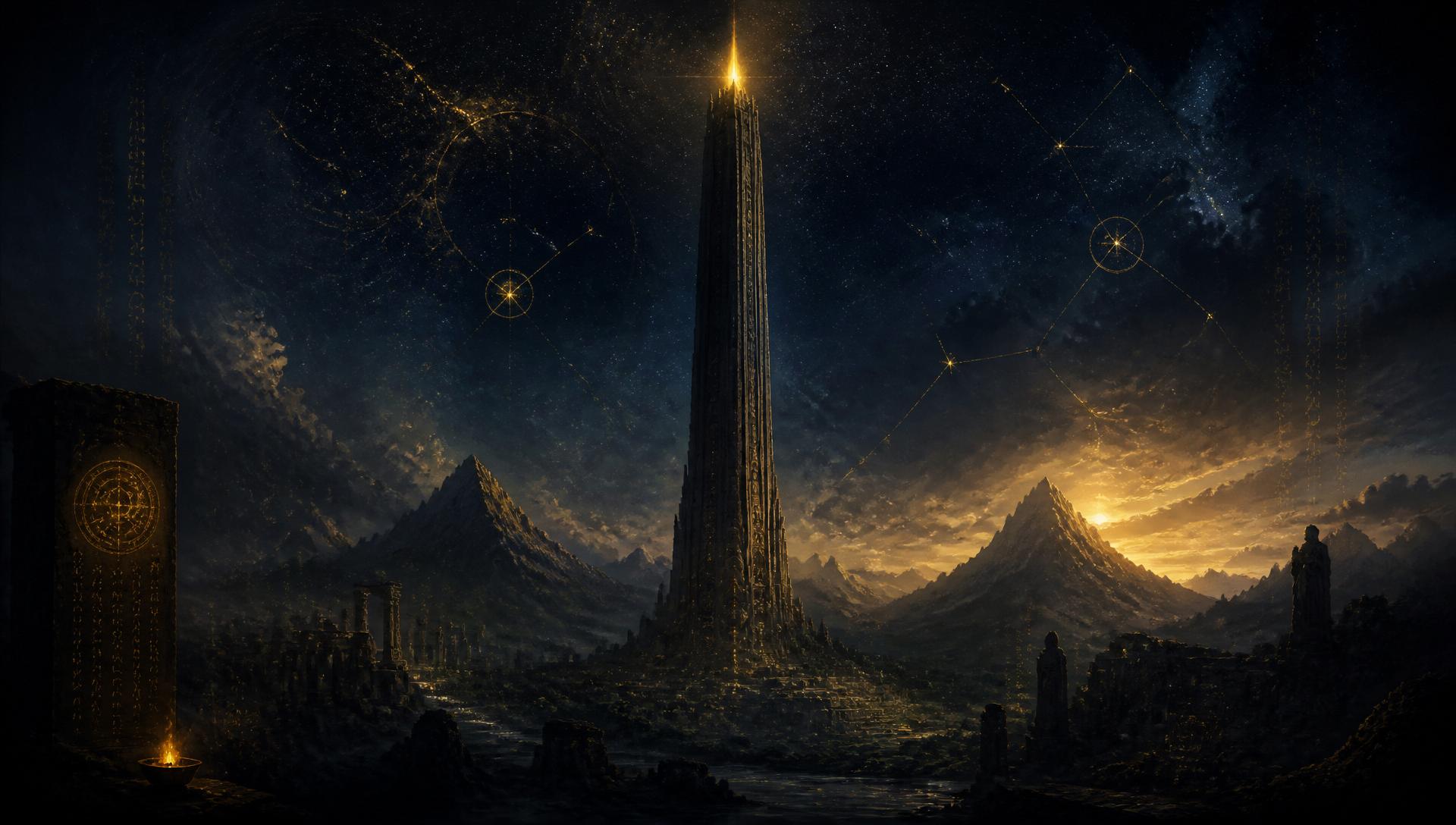
Some worlds begin with a map.
Others begin with a character, a battle, or a single line written at the top of an empty page.
Elyria began much earlier than that.
Its roots reach back to childhood—to years spent reading, imagining, questioning, and wondering what might exist beyond the edge of the known world. Long before the Eternal Tower had a name, long before the Flame became part of a story, there was already a fascination with worlds larger than our own.
Fantasy and science fiction opened the first doors. History, mythology, philosophy and religion opened others. Over time, those doors began to connect.
I did not know then that I was building Elyria.
I was simply remembering pieces of a world that did not yet exist on paper.
A world carried quietly
For many years, Elyria remained private.
There was no publishing plan. No launch date. No audience waiting for the next chapter.
There were only ideas.
Some appeared and disappeared. Others remained for years. Certain questions returned again and again: What happens when knowledge becomes more powerful than those who seek it? What does a civilisation choose to preserve? What is the difference between power and wisdom? Why do some ideas survive the people who first carried them?
These questions gradually became part of the foundations of Elyria.
But imagination was only one part of the process.
Life added the rest.
Years at sea taught me the scale of the world. Travel revealed how different civilisations can be, and how much they still share. Work taught me responsibility, discipline and the quiet effort behind anything built to last. Starting again in another country taught me that crossing a border can change far more than geography.
Leadership brought different lessons: that decisions have consequences, that knowledge carries responsibility, and that building something meaningful rarely happens quickly.
None of these experiences was collected for a fantasy novel.
But all of them found their way into Elyria.
The Tower and the Flame
At the heart of the world stands the Eternal Tower.
It is not simply a building, just as the Flame is not simply fire.
Both grew from ideas that had followed me for years: the preservation of knowledge, the rise and fall of civilisations, the danger of forgetting, and the possibility that what one generation leaves behind may shape generations it will never see.
The Tower became a place where those questions could live.
The Flame became something more difficult to define.
Power, knowledge, memory, responsibility—perhaps it is all of these, and perhaps it is something else entirely.
I have never wanted Elyria to explain everything immediately.
Real worlds do not reveal themselves that way.
We understand them slowly: through fragments, stories, symbols, places, histories and the lives of those who came before us.
Elyria should be entered in the same way.
Why it took so long
People sometimes speak about writing as though the most important moment is the moment you begin typing.
I do not think that is always true.
Some books begin long before the first sentence.
They begin while reading something that changes the way you think. While standing somewhere you will remember decades later. While learning from a mistake. While watching people build, lose, protect or rebuild something that matters to them.
For a long time, I was not ready to write Elyria.
The world needed more than imagination. I needed more life.
That is why I do not regret the years of quiet work.
A world built too quickly might have contained more pages, but fewer foundations.
When the world finally became a book
Eventually, the ideas began to gather around one story.
That story became The Book of the Flame — Elyria: The Eternal Tower.
It was the first time a world carried for so long became something another person could enter.
Publishing it did not feel like completing Elyria.
It felt like opening the first door.
There are histories still unwritten. Civilisations only partly understood. Maps that remain unfinished. Characters waiting beyond the edge of the present story. Symbols whose meaning has not yet been revealed.
And somewhere beyond them are the future Chronicles of Elyria.
They will come when they are ready.
I have no interest in rushing a world that took so long to find its voice.
An archive still being written
This is why I think of Elyria not simply as a series, but as an archive.
The Flame.
The Eternal Tower.
The timeline.
The maps.
The civilisations.
The philosophy.
The characters.
The symbols.
Each is a doorway into something larger.
Over time, some doorways may become books. Others may become stories, fragments, maps or chronicles. Some may remain closed until the right moment arrives.
That uncertainty is part of the joy of building a world.
I know more about Elyria today than I did when I began writing the first book.
I also know how much of it I have yet to discover.
The quiet work continues
Val Publishing House was created with a simple belief: books worth keeping should be built with patience.
Elyria asks for the same patience.
The world has been with me, in one form or another, since childhood. The last decade gave it greater shape. Life gave it experience. Writing gave it a voice.
Now readers can enter.
But the doors have only just begun to open.
— Valentin Petkov
Founder, Val Publishing House