Some pages arrive easily.
Others wait.
They are written, left alone, found again, questioned, changed and sometimes abandoned—only to return months or years later with a meaning they did not have before.
Writing is often described as the discipline of beginning.
I think it is also the discipline of returning.
The unfinished page
I have always been surrounded by ideas.
Some become notes.
Some become questions.
Some remain only as a sentence, a title, an image or the beginning of something I do not yet understand.
Not every idea needs to become a book.
Not every page needs to be finished immediately.
But certain ideas refuse to disappear.
You close the notebook.
Life moves on.
Then one day, the idea returns.
Sometimes it has changed.
Sometimes you have.
That difference matters.
A page you could not finish years ago may become clear because experience has finally given you the words it was waiting for.
Why I return
Returning to a draft is not the same as repeating the work.
The writer who comes back is never exactly the writer who left.
Between one version and the next, life happens.
You read more.
You learn more.
You make mistakes.
You change your mind.
You understand something that once seemed impossible to explain.
This is why I do not see an unfinished draft as a failure.
Sometimes it is simply early.
The difficult part is knowing the difference between a piece that needs more work and one that needs more time.
There is no formula for that.
Only patience, attention and the willingness to return.
The notebook remembers
A notebook does not judge an idea by what it may become.
That is one reason I value it.
A few words can wait beside a question.
A fragment can remain unfinished.
A thought can exist without needing to justify itself.
Years later, those small records can become unexpectedly important.
They remind us not only of what we were thinking, but of who we were when we thought it.
Some ideas remain exactly where they began.
Others become pages.
A few become books.
And sometimes, many separate notes turn out to have been parts of the same world all along.
The draft changes the writer
We often think revision exists to improve the text.
It does.
But the process works in both directions.
The draft also changes the person returning to it.
It teaches patience.
It exposes habits.
It reveals where we are pretending to know something we do not yet understand.
It forces us to decide what matters enough to keep.
There is humility in deleting a sentence you once thought was brilliant.
There is discipline in rewriting a paragraph for the fifth time.
And there is wisdom in knowing when another revision will no longer make the work better—only different.
Returning to Elyria
Elyria is perhaps the clearest example of this process in my own writing.
The world existed in imagination long before it existed as a finished book.
Ideas returned.
Questions deepened.
Life added experience.
What could not have been written earlier slowly became possible.
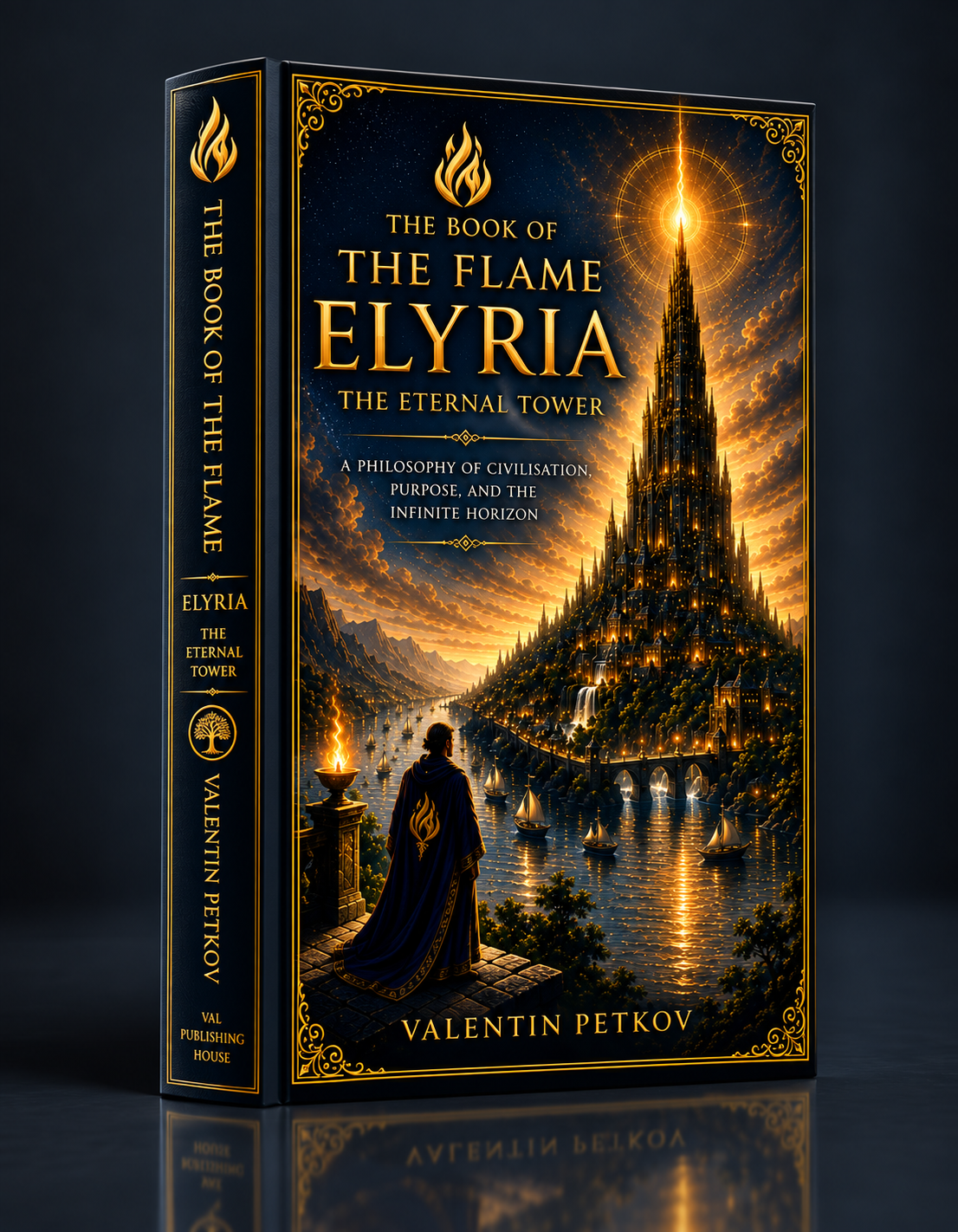
Even now, publishing The Book of the Flame — Elyria: The Eternal Tower has not ended that process.
There are still notes.
Still unanswered questions.
Still parts of the world waiting for their time.
The difference is that I no longer see the waiting as empty space.
It is part of the work.
Returning to a life
Beyond Borders required a different kind of return.
Instead of returning to an imagined world, I returned to my own life.
The sea.
The ships.
The countries.
The work.
The move to the United Kingdom.
The changes brought by Brexit.
The years that followed.
Memory is its own kind of draft.
We carry events for years, often without understanding what they meant.
Then distance changes the view.
Separate experiences begin to connect.
A life that once felt like a series of unrelated chapters reveals a thread running through them.
Writing the book required returning to those moments—not to live them again, but to understand what they had become.
The discipline is in coming back
Inspiration is valuable.
But inspiration is not always available when the work needs us.
The page does not finish itself because the first idea was exciting.
At some point, writing becomes quieter.
You return.
You read.
You question.
You remove.
You rebuild.
Then you leave it again.
And later, you return once more.
This may not be the most dramatic part of writing, but it is where much of the real work happens.
The finished page often hides the number of times someone came back to it.
Perhaps that is as it should be.
The reader does not need to see every draft.
Only the page that was finally ready to remain.
Some things are worth returning to
Not every abandoned idea should be rescued.
Not every old draft deserves another year.
Part of the discipline is learning what to leave behind.
But some ideas continue to call us back.
A world.
A memory.
A question.
A sentence that still has not found the words around it.
When that happens, I return.
Not because the work is unfinished.
Because sometimes I am not finished with it.
— Valentin Petkov
Author and Founder of Val Publishing House